
AI contact center companies are transforming how businesses connect with their customers. Gone are the days when long wait times, repeated explanations, and inconsistent service were acceptable. Customers now expect quick, personalized, and seamless support across multiple channels. To meet these expectations, businesses are adopting a modern call center software platform that combines artificial intelligence with human expertise.
An AI contact center allows companies to manage more customer interactions efficiently while still providing a personal touch. These platforms include intelligent routing, real-time agent guidance, automated responses, and performance insights, helping teams scale support without sacrificing quality.
Being able to scale effectively has become a significant advantage. Businesses that can handle spikes in demand—whether from seasonal peaks, product launches, or unexpected issues—without adding extra staff stand out in competitive markets. AI contact centers provide the tools and flexibility needed to manage high volumes of interactions while keeping customers satisfied and agents productive. Nation AI contact centers provide the tools and flexibility needed to manage high volumes of interactions while keeping customers satisfied and agents productive.
Core Pillars of an AI-Driven Contact Center
Intelligent Self-Service: Conversational AI and Chatbots
One of the core pillars of modern AI contact centers is intelligent self-service. Chatbots and conversational AI allow customers to resolve common queries independently, such as checking order status, resetting passwords, or updating account information. This reduces wait times, improves first-call resolution, and ensures agents focus on complex, high-value interactions.
For example, a customer looking to track a shipment can interact with a chatbot and get an instant response, freeing the human agent to handle a more nuanced issue, such as troubleshooting a technical problem. By delivering instant, accurate answers, AI contact centers enhance the customer experience while improving operational efficiency.
Predictive Routing: Connecting Customers with the Right Agents
Another essential feature of AI contact centers is predictive routing, which matches customers to the most suitable agent based on factors like their issue type, history, and preferred communication channel. This approach not only boosts first-call resolution but also increases customer satisfaction by minimizing frustration and repeat calls.
For instance, a VIP customer with a billing issue can be routed immediately to an agent trained in handling premium accounts. Predictive routing ensures that every interaction is as smooth and effective as possible.
Omnichannel Integration: One View of the Customer
Customers today engage with businesses through multiple channels—phone, chat, email, social media, and even SMS. AI contact centers integrate these touchpoints into a single platform, giving agents a unified view of the customer journey.
This omnichannel integration ensures that conversations are consistent, context-aware, and seamlessly transferred between channels. For example, a customer starting a query on chat can switch to a phone call without repeating information, which improves satisfaction and reduces frustration.
Top AI Contact Center Solution Providers
Several companies are leading the way in AI contact center innovation, helping businesses transform customer support with intelligent automation and analytics.
1. Bright Pattern – Intelligent Omnichannel AI Contact Center
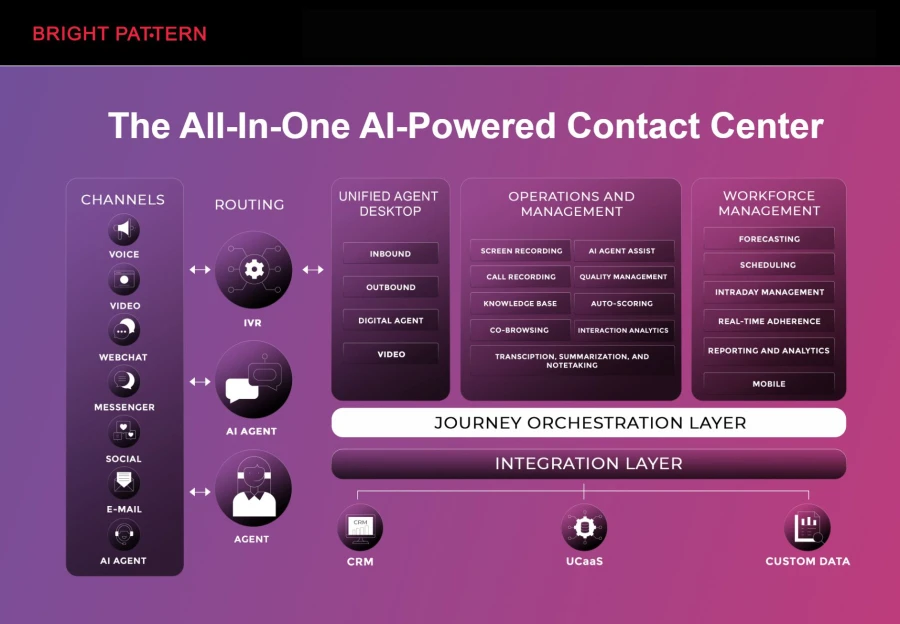
Bright Pattern stands out as a leading AI contact center solution, providing businesses with a powerful platform that unifies communication across voice, chat, email, SMS, and social media. Its omnichannel approach ensures that every customer interaction, regardless of the channel, is seamless, consistent, and personalized.
Key features of Bright Pattern include:
- Predictive Routing: Smart AI algorithms match customers with the most suitable agent based on their inquiry, history, and preferences, improving first-contact resolution.
- Agent Assist: Real-time AI guidance helps agents access knowledge, recommended responses, and next-step suggestions during conversations, increasing efficiency and reducing handling time.
- Analytics Dashboards: Comprehensive reporting and dashboards provide insights into agent performance, customer sentiment, and overall service metrics, helping managers make data-driven decisions.
- Automation and Self-Service: Bright Pattern’s AI chatbots and virtual assistants handle routine questions 24/7, reducing call volume and freeing agents for complex tasks.
- Seamless CRM Integration: The platform integrates with popular CRM systems, ensuring that agents have immediate access to customer context for a more personalized experience.
- Scalability: Bright Pattern supports businesses of all sizes—from small and medium enterprises to large global operations—allowing teams to scale quickly during peak demand without compromising service quality.
What sets Bright Pattern apart is its focus on combining AI-driven efficiency with human empathy. Customers benefit from faster, smarter support, while agents gain tools that empower them to focus on meaningful problem-solving. Many organizations have reported higher customer satisfaction, lower operational costs, and improved agent retention after adopting Bright Pattern’s AI contact center platform.
2. Genesys – AI-Enhanced Customer Experience
Genesys integrates AI to optimize customer journeys with chatbots, predictive routing, and sentiment analysis. Enterprises use Genesys to provide proactive, tailored support that improves satisfaction and reduces resolution time.
3. Five9 – Cloud Contact Center with AI Capabilities
Five9’s cloud platform incorporates AI-driven virtual agents, intelligent routing, and real-time analytics, enhancing productivity and customer experience. The platform is designed to help organizations scale efficiently while maintaining high service quality.
4. Talkdesk – AI-Powered Customer Experience Platform
Talkdesk leverages conversation intelligence, workflow automation, and predictive engagement to deliver smart AI contact center solutions. Its seamless integration with CRM systems ensures agents can provide personalized support efficiently.
5. Amazon Connect – Scalable AI Contact Center from AWS
Amazon Connect uses AWS AI and machine learning to provide cloud-native AI contact center solutions. Features include automated workflows, omnichannel support, and analytics for continuous optimization, enabling businesses to scale with ease.
6. Zendesk – AI Assistance for Omnichannel Support
Zendesk integrates AI to offer automated responses, agent assistance, and actionable insights, helping teams streamline workflows and deliver consistent service across multiple channels.
7. ServiceNow – AI-Driven Service Management
ServiceNow focuses on intelligent routing, predictive analytics, and workflow automation, enabling agents to resolve queries faster and improve overall efficiency in an AI contact center environment.
Boosting Efficiency with AI Contact Center Tools
Agent Assist Technology: Guidance in Real Time
AI contact centers offer agent assist technology, which provides real-time suggestions and knowledge retrieval during interactions. Agents can access recommended responses, relevant knowledge articles, and next-step guidance instantly. This improves accuracy, reduces average handle time, and empowers agents to confidently manage inquiries, even complex ones.
Automated Transcription and Summarization: Reducing After-Call Work
Documenting interactions is time-consuming, yet essential. AI contact centers automatically transcribe conversations and generate summaries, cutting down on after-call work (ACW) significantly. Agents can move to the next customer faster, improving overall efficiency and reducing stress.
Sentiment Analysis: Understanding Customer Emotions
Modern AI contact centers analyze tone, word choice, and sentiment to understand the “why” behind interactions. Detecting whether a customer is frustrated, confused, or satisfied allows agents to tailor their responses accordingly. This capability not only improves the customer experience but also helps managers identify trends, recurring issues, and areas for training.
Solving the Scalability Challenge
Managing High Volume Without Extra Staff
AI contact centers allow businesses to handle sudden spikes in demand without hiring additional staff. During seasonal peaks, product launches, or marketing campaigns, the platform automatically scales to meet increased interaction volumes. This flexibility ensures that service levels remain high, even under pressure.
24/7 Automation for Routine Inquiries
AI contact centers can manage routine questions around the clock. Whether it’s checking an account balance, tracking a delivery, or updating a profile, AI automation ensures customers receive instant assistance, any time of day. This not only reduces inbound volume for human agents but also enhances customer satisfaction with timely, consistent responses.
Cutting Costs While Improving Speed
Automation and AI tools streamline workflows, reduce repetitive tasks, and optimize resource allocation. As a result, AI contact centers lower operational costs while improving speed to resolution, helping businesses deliver a better customer experience without increasing headcount.
Enhancing the Agent Experience (EX)
Reducing Burnout Through Automation
Repetitive tasks are a major source of agent burnout. AI contact centers take over these duties, allowing agents to focus on problem-solving, customer engagement, and meaningful work. Reducing stress and monotony improves retention and team morale.
Empowering Agents for Complex Issues
With AI handling routine tasks, human agents can dedicate their time to complex issues requiring judgment, empathy, and creativity. This combination of machine efficiency and human intelligence enhances the overall quality of customer service.
Continuous Learning Through AI Analytics
AI contact centers monitor agent performance and provide actionable insights. Analytics highlight strengths, identify gaps, and suggest training opportunities, fostering a culture of continuous improvement and professional growth for agents.
Implementation Strategies for Modern Enterprises
Seamless CRM Integration
For maximum impact, AI contact centers should integrate with existing CRM systems. This ensures agents have access to real-time customer data, interaction history, and context, enabling highly personalized service without switching between multiple platforms.
Data Privacy and Security
Handling sensitive customer data requires strong security measures. AI contact centers implement robust encryption, access controls, and compliance with regulations such as GDPR or CCPA, protecting both customers and businesses.
Measuring Success Beyond Handle Time
Traditional metrics like Average Handle Time (AHT) are no longer sufficient. AI contact centers track advanced KPIs, including customer satisfaction, first-contact resolution, sentiment scores, and automation adoption rates, providing a more complete picture of operational effectiveness.
Future Trends: What’s Next for AI in Support?
Hyper-Personalization with Generative AI
Generative AI will allow AI contact centers to craft highly personalized interactions, tailoring recommendations and responses to each customer’s unique history and preferences. This level of personalization strengthens loyalty and improves overall satisfaction.
Proactive Customer Support
Future AI contact centers will anticipate problems before they occur. Predictive analytics and automation can alert customers and offer solutions proactively, reducing inbound contact volume and demonstrating exceptional service.
From Cost Center to Revenue Generator
AI contact centers are evolving from cost-saving tools into revenue-driving platforms. By supporting upselling, cross-selling, and retention-focused interactions, these centers contribute directly to business growth while maintaining high-quality support.
Conclusion: Embracing the AI Contact Center Revolution
Investing in an AI contact center is no longer optional—it’s essential for businesses seeking scalable, efficient, and high-quality customer support. By combining machine intelligence with human empathy, AI contact centers handle more interactions, reduce operational costs, and deliver personalized, consistent service.
The future of customer support lies in this balance. Companies that embrace AI contact centers today will not only optimize operations but also build stronger relationships with customers, turning service into a strategic advantage and a driver of long-term business growth.

Emma Rose is the founder of TryHardGuides.co.uk and a senior content strategist specializing in lifestyle, personal development, and digital entrepreneurship. With a focus on evidence-based living, she produces actionable content designed to help readers make informed life decisions and navigate the evolving tech-lifestyle landscape. As the editorial lead, Emma oversees the site’s mission to provide trustworthy, high-authority information. Her work reflects a commitment to personal growth, transparency, and the pursuit of a well-balanced, informed life.