
Every version of Spider Solitaire uses the same 104 cards and the same 10-column layout. The goal never changes either: build complete King-to-Ace sequences and clear the board. But the number of suits you pick completely transforms the experience.
One suit is a relaxing puzzle. Four suits will make you question your life choices. And two suits sits right in the middle, where most players eventually land.
So which version actually fits the way you play? Let’s break each one down.
The 1 Suit Game Is Your Warm-Up Round
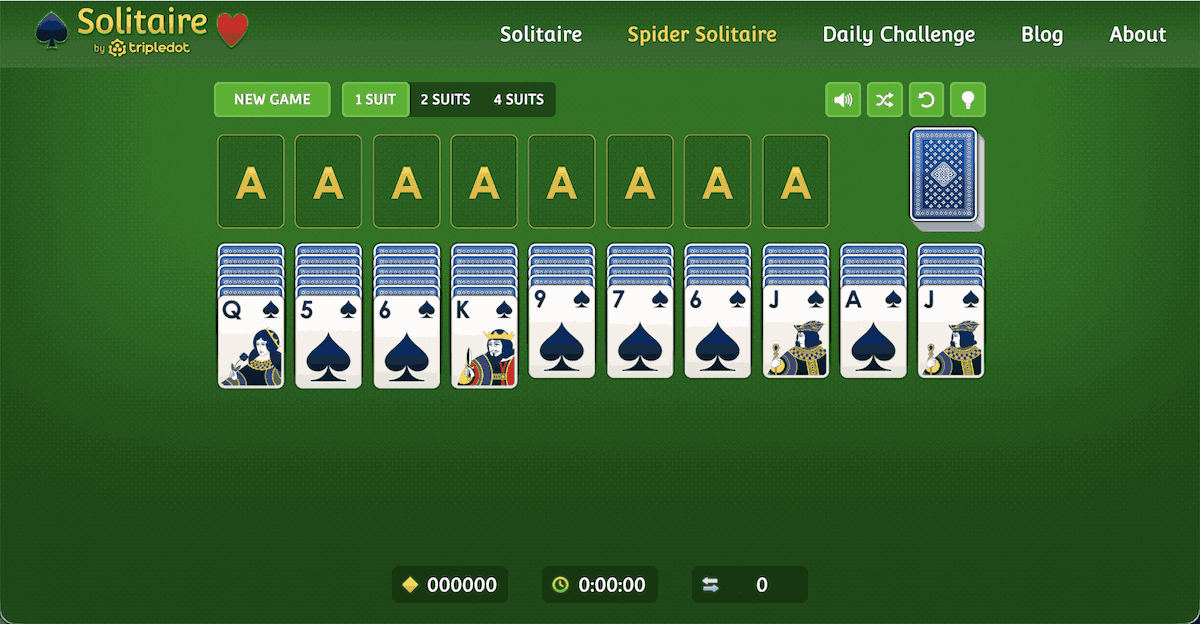
One-suit Spider Solitaire uses eight copies of a single suit, usually spades. Because every card shares the same suit, you never have to worry about colour matching or suit conflicts. Any descending sequence you build is automatically valid and can be moved as a group.
This makes 1-suit games winnable roughly 60 to 80% of the time, depending on skill level and how win rates are measured. That generous range keeps games feeling rewarding without being mindless.
Your main strategy here is simple: uncover face-down cards as fast as possible and keep columns open. Since suit conflicts don’t exist, you can focus entirely on card ordering and stockpile management.
A typical 1-suit game wraps up in about 10 minutes. It’s perfect for quick sessions, learning the basic mechanics, or just unwinding without too much mental strain. If you’ve never played Spider Solitaire before, start here.
2 Suits Is Where the Real Game Begins
Two-suit Spider Solitaire uses two suits, typically spades and hearts. This single change flips the difficulty on its head. You can still stack any card on a higher-value card regardless of suit. But here’s the catch: only same-suit sequences can be moved together or sent to the foundation.
That rule changes everything.
Suddenly you’re juggling two competing priorities. You want to build long runs to free up columns, but mixing suits locks those runs in place. Every move becomes a trade-off between short-term flexibility and long-term progress.
The win rate drops to roughly 16 to 20% for experienced players. That’s a fraction of what you get with one suit. Beginners will win far less often until they learn to prioritise same-suit builds and manage their stockpile draws carefully.
Key strategies for Spider Solitaire 2 Suits include:
- Prioritise same-suit sequences even when a mixed-suit move seems easier
- Reveal hidden cards first. Always pick the move that exposes a face-down card
- Place Kings in empty columns since they give you the longest possible building space
- Delay stockpile draws until you have exhausted every available move on the tableau
Games typically run 15 to 25 minutes. This is the version most regular players settle into once 1-suit stops being a challenge.
4 Suits Is Spider Solitaire on Hard Mode
Four-suit Spider Solitaire is the full, original version of the game. All four suits are in play across both decks, giving you 26 cards of each suit spread randomly across the tableau and stockpile.
The win rate? Roughly 5 to 8% for skilled players. Some datasets tracking tens of thousands of games show win rates closer to 6%. That’s not a typo. You will lose the vast majority of your games, and that’s completely normal.
With four suits in the mix, almost every sequence you build will contain mixed suits. Moving partial sequences becomes extremely restricted. You need to think several moves ahead, anticipate which cards the stockpile might deliver, and sometimes sacrifice progress in one column to unlock a key card in another.
The strategies that worked in 2-suit games still apply here but with much tighter margins for error:
- Empty columns are gold. Protect them and use them as temporary holding spaces
- Avoid dealing from the stockpile until you have zero other options
- Focus on completing one or two suits first rather than spreading your effort across all four
- Accept that some deals are unwinnable: Recognising a lost cause early saves time
A 4-suit game can take 30 minutes to well over an hour. This variant is built for players who want a genuine mental challenge and don’t mind losing nine games out of ten.
Which Version Should You Play?
If you are brand new to Spider Solitaire, start with 1 suit. No question. Learn how the stockpile works, practise clearing columns, and get comfortable with the flow of the game. Once you win consistently, you have outgrown it.
Move to 2 suits when 1-suit games feel automatic. The jump in difficulty is significant but fair. You will lose more often, and that’s the point. Two suits teaches you the suit-management skills that define Spider Solitaire at every level.
Pick 4 suits only when you genuinely enjoy the puzzle of a near-impossible challenge. This version rewards patience and careful planning. It’s not for everyone, and there’s no shame in sticking with 2 suits long-term. Many experienced players do exactly that.
The best version of Spider Solitaire is the one that keeps you coming back. Start easy, move up when you’re ready, and don’t rush the progression.
You May Also Like: EuroGamersOnline the Different Types Revealed: All Secrets

Evelyn White is a gaming content strategist and logic specialist with a background in interactive media and puzzles. She leads the Gaming section, focusing on data-driven solving guides and modern puzzle trends. From daily word game strategies to complex logic grid breakdowns, Evelyn’s goal is to improve reader skills through actionable tips and expert analysis. She monitors thousands of gameplay challenges to identify the most efficient strategies, ensuring that every guide provides genuine value and helps players master their favorite games.