
Underfloor heating has gone from the item you’d find in a luxury new build to a bona fide option for the everyday homeowner, and when you live with it, it’s hard to return to cold tiles on a wintry morning. But the installation side of things puts many people off, more so because they don’t understand what goes into the process. It relies on many factors; there’s no blanket approach to how it’s installed without considering the system and what’s underneath your floor, which means that it helps to have a visual before anything gets ripped up.
Two Systems, Two Completely Different Jobs
The first step in any underfloor heating project is choosing an electric or wet (or hydronic) system. They’re not two halves of the same concept, how they operate, their running costs, and installation are worlds apart.
Electric systems use heating cables or mats that sit beneath the floor covering. Wet systems push warm water through pipes connected to a boiler or heat pump. It’s worth looking at some of the Underfloor Heating Kits available from the get-go to understand what goes into each project to better inform the decision between systems.
Electric tends to work better in smaller rooms, bathrooms, kitchens and maybe a hallway. Wet systems require much more initial work but make much better sense for larger rooms or entire homes. They work better if part of a renovation already being undertaken so as to not create additional disruption.
How Electric System Installation Works
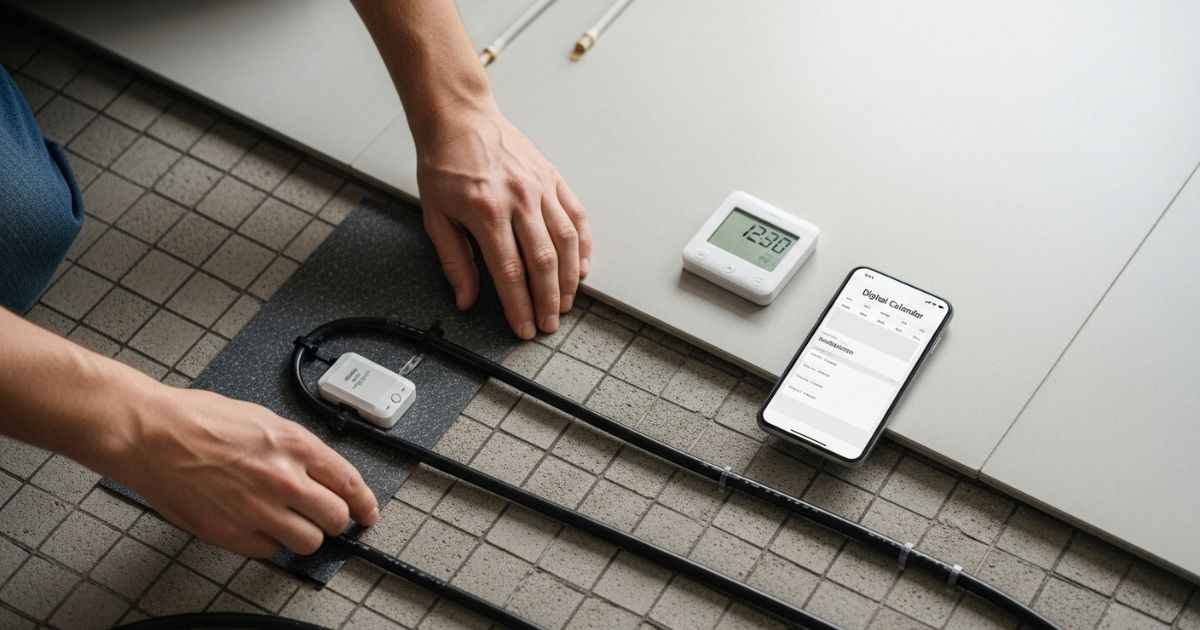
Electric underfloor heating is the easier system to install of the two. An initial inspection beneath the subfloor needs to be conducted, it cannot be uneven, dirty or damaged. If it is, once something is placed on top, there’s no going back. The heating mat or cable is rolled out onto the subfloor, and thought needs to go into its layout. Cables can’t be too close together and shouldn’t be positioned under permanent furniture, trapping heat without adequate means of dispersal equals damage down the line.
Once laid out, a self-levelling compound or floor adhesive will go on top, followed by floor finish. A thermostat needs to be wired in, this is where most people call in an electrician for support, which is probably the best move. In a single room, it’s often a quick job which can be completed in a day. It’s not an easy task, per se, but it isn’t life destroying.
How Wet System Installation Works
Wet underfloor heating is a bigger job, it’s important to acknowledge that from the start. Pipes need to go somewhere, and that often means ripping up existing floors entirely or raising the height of the floor with a screed layer that encompasses the piping. This isn’t a consideration for new builds; it’s just part of the process. In older homes, it requires more pre-planning.
Raising the floor, even slightly, has implications for door heights and skirting boards that might need to be removed and reattached. If there’s kitchen cabinetry or fitted wardrobes involved, proper planning needs to occur before any install day happens because additional obstacles may exist that no one thought about beforehand.
Pipes are laid in a continuous loop designed to disperse heat evenly across the room, connected to a manifold (the central part where control over individual zones exist) connected back to the boiler/heat pump. The system needs to be pressure tested before any cover is installed over top. Screed gets poured over top and this is where patience comes into play. Screed takes weeks to cure, and the heater needs to be gradually brought up in temperature over days, rushing this process makes screed crack (not a big deal but not preferred by anyone).
Choosing The Floor Covering
The floor covering choice is more important than people give it credit for. Tile/stone works best, they hold heat efficiently and disperse them consistently over time. Engineered wood works well; solid wood is less predictable (it shifts with temperature/humidity changes) so careful wood selection is imperative alongside its acclimatization time.
Carpet is where things get sticky. The thicker and heavier the carpet, the more insulation it provides (which is not what any underfloor heating should do). Thin carpet low tog underlay can work but it’s better to figure that situation out before installation rather than trying to make it work afterwards.
What Most People Underestimate
More often than not, people do not account for the design/pre-planning phase enough. There’s no guesswork in where cabling or piping goes, it all depends on how much heat a room loses (or retains), how insulated it is and what the finish will be on top; getting this calculation right means effective functioning for years to come.
Furthermore, proper insulation beneath the system is just as crucial. Without insulation going downwards, heat escapes downward rather than up, making the system work harder than necessary.
When it’s done properly, underfloor heating is truly one of those upgrades that transforms how space feels to live within. It requires proper planning and often professional assistance, but once it’s running, it’s one of the last things people regret adding into their homes.
You May Also Like: What to Think About When Installing a Septic Tank

Alex Taylor is a seasoned technology writer and systems specialist with over 5 years of experience in hardware maintenance and digital troubleshooting. He specializes in practical tech guides, focusing on making complex technical repairs and software optimization accessible to everyday users. Alex personally reviews and fact-checks every guide to ensure that maintenance tips are safe, effective, and budget-friendly. Whether it’s a hardware fix or a software setup, his work is driven by a passion for technical clarity and real-world utility.